Lyophilisation vials in the freeze-drying process

Your applications Freeze-drying

Freeze drying, also known as sublimation drying, is the lyophilisation/drying of products using thermal energy and is used for drying pharmaceutical products such as vaccines and bacteria.

The material dried in this way is called the lyophilisate.

Water-containing products, such as medicines, food or organic and other porous materials, are deep-frozen to as low as -55 °C in order to subsequently dry the product under vacuum conditions. The sublimation drying process is used here, in which water is converted directly from a solid state to a gaseous state.
In the freeze dryer the product is dried at a negative pressure of less than 6 mbar. Under the influence of this negative pressure, the frozen water no longer assumes the liquid phase during the entire drying process, but changes directly from the solid state to the vapour state. This process is called sublimation.

What is lyophilisation?

Lyophilisation is a technical process for removing water by means of sublimation drying. This is achieved through a freezing phase and a drying phase of the product, whereby the water is removed from the product via sublimation drying. By removing water, the structural properties of the product are retained, resulting in longer shelf lives and improved stability.</p

If a solution of an amorphous substance is present, it changes into a glassy state. Stabilisation of the starting products in the freezing phase is achieved by so-called cryoprotectors.
The cryoprotectors stabilise the starting product by increasing viscosity or prefentional exclusion. The latter means that the protein is kept in its native form by adding certain substances such as polyols or carbohydrates.
A vacuum is then applied for sublimation drying, which sublimates the ice and removes the water from the frozen solution.

The lyophilisation process consists of several steps. First, the product is filled into containers or vessels in liquid form. It is then quickly frozen, often using refrigerants such as liquid nitrogen or R729. Once the product is frozen, the pressure in the freeze dryer is reduced and the water in the product is removed by sublimation. The water passes directly from the solid phase to the gaseous phase. This process step is known as primary drying. This process can take several hours or even days, depending on the size and type of product. In the subsequent secondary drying process, the temperature in the product is increased in order to remove any residual water. What remains is the dissolved substance as a porous cake with a large surface area, which can later be easily dissolved in water again. In the final step, the dried product is sealed to keep moisture out of the environment.</p

Principle of lyophilisation in the pharmaceutical industry

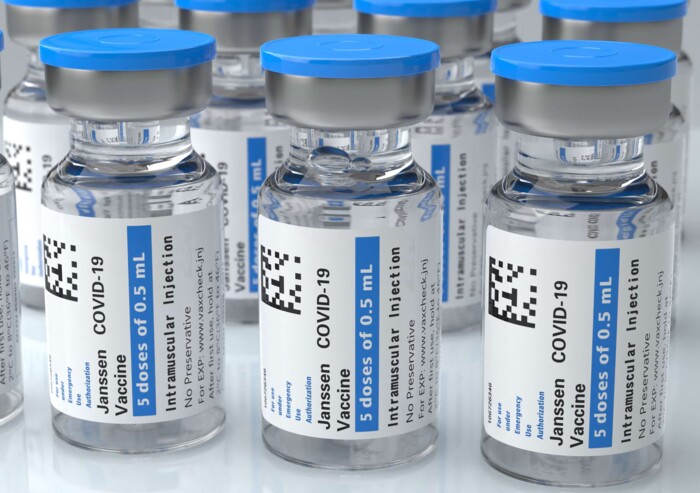
In the pharmaceutical industry, lyophilisation plays an important role in the production and preservation of medicines. The freeze-dried form makes medicines more stable and gives them a longer shelf life. This is particularly important for vital medicines that have to be stored and transported under certain conditions. Lyophilisation enables the production of powder formulations that can be rehydrated quickly, making them easier to dose and use.

Vials for use Pharmaceutical freeze-drying

Principle of lyophilisation in the food industry

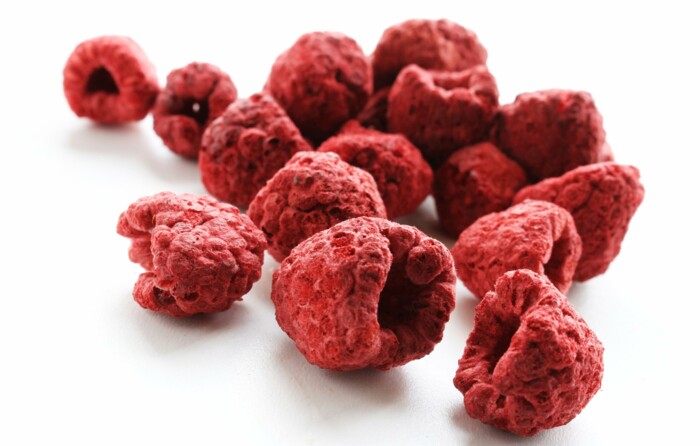
In the food industry, foods such as fruit, instant coffee or soups are freeze-dried. By removing the water the shelf life is extended and the weight is reduced, making it easier to transport and store in a frozen state. Freeze-dried food also retains its nutritional composition and flavour, which helps to provide high-quality products.

Freeze-dried raspberries

Applications and advantages of lyophilisation

As explained above, lyophilisation is used in various industries, including the food and pharmaceutical industries.

Freeze drying offers several advantages over conventional drying processes such as hot air drying. By freezing the goods, the structural properties are preserved, resulting in better rehydration. Lyophilisation also makes many food and pharmaceutical products lighter and more compact, which facilitates logistics and storage. In addition, the taste and nutritional composition is preserved, as no high temperatures are used that could lead to losses or changes.
Lyophilisation is a complex process that requires careful planning and monitoring. Selecting the appropriate freezing and drying agents and controlling the temperature and pressure are crucial to achieving a high-quality end product. In addition, the right packaging materials must be used to protect the dried product from humidity and other environmental influences.</p

Another important aspect of lyophilisation is the validation of the process. This involves carrying out tests to ensure that the product has the required characteristics and meets the requirements. The tests include determining the residual moisture, particle size and stability of the product.</p

Freeze drying is also used in R&D to develop new products and formulations. By combining lyophilisation with other techniques such as microencapsulation, innovative products with improved properties can be manufactured.

<p

Overall, lyophilisation is an important process used in various industries to extend the shelf life of products and improve their stability. By removing water, the structural characteristics of the product are preserved, resulting in better quality. The controlled environment and careful planning are crucial to achieving ideal results.

background image

Advantages of freeze-drying

Drying of the product

No mould formation and extended half-life

Proven drying process for paper

Gentle conservation of historical books & papers

Preservation of the flavourings

Increased intensity of flavourings in food

Preservation of proteins & medicines

Substances in the pharmaceutical industry are preserved for longer

background image

Disadvantages of freeze drying

High investment costs

High acquisition costs

High energy consumption

High level of thermal energy required

Freeze-drying systems for the industry

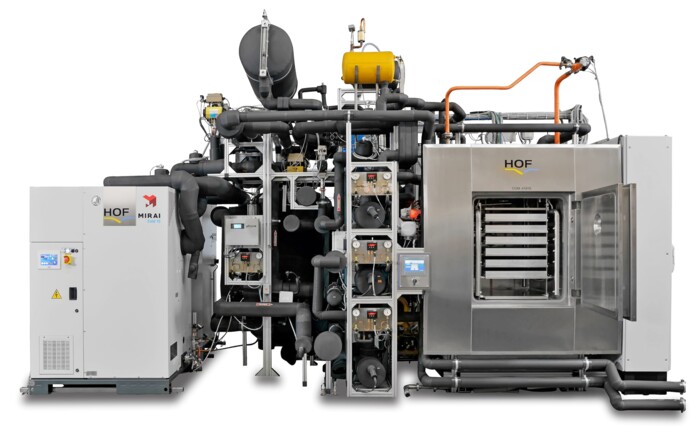
Industrial freeze dryers usually consist of two chambers. One chamber contains shelves through which cryogenic or heated silicone oil can flow, on which the product or the aqueous solution is filled in vials (glass bottles). Temperatures from - 55 °C to + 40 °C can be realised in this chamber.</p

The second chamber is the so-called condenser, where the sublimated moisture from the product collects. The condenser is cooled via cooling coils, which are also flooded with silicone oil. Temperatures of -60 °C to -80 °C are reached via a circuit with compressors and evaporators. It is therefore the coldest point in the system. Both chambers can be separated from each other by a flap (intermediate valve). However, they are connected to each other during drying. A vacuum pump is also connected to the condenser.</p

The first chamber, which is also a vacuum chamber, enables the water to be removed by sublimation, while the refrigeration system is responsible for freezing the product. The containment system protects the dried product from moisture and other harmful influences.</p

The respective degree of the drying process can be precisely determined using attached measuring instruments. This is made possible by a manometer. Both Pirani pressure gauges and conductometric pressure gauges are used.

HOF CryoBlizzard" freeze-drying system

History & future of lyophilisation

Lyophilisation has a long history and was first developed in the 1940s. Initially, the process was mainly used to preserve blood and serums in medical research. However, it was quickly realised that lyophilisation could also be beneficial for other food and pharmaceutical products, and so lyophilisation began to gain traction in various industries.

<p

In the early years of lyophilisation, applications were mainly focused on medical and military fields. Freeze-drying enabled the long-term storage of medicines, blood plasma and vaccines, which was particularly important in military supplies. It also enabled the production of blood products in powder form, which could be rehydrated if required.</p

In recent decades, significant advances have been made in lyophilisation technology. Equipment and machinery have been improved to make the process more efficient and controllable. New refrigerants and vacuum systems have been developed to speed up sublimation and shorten drying times. In addition, there are increased efforts in the formulation of products to further improve stability and rehydration properties.

<p

Lyophilisation could find further areas of application in the future. For example, work is underway to develop lyophilisation techniques for the manufacture of personal care products such as creams and lotions. Lyophilisation could also be used in nanotechnology to produce nanostructured materials. With advancing technology and research, the possibilities for freeze-drying are endless.</p

Overall, lyophilisation offers an effective method for preserving and stabilising products in various industries. With advances in technology and ongoing research, lyophilisation will continue to play an important role and offer new opportunities for product development.

Here you will find suitable products and services

Matching products

Suitable services

For the right system technology, it is important to analyse the parameters from the formulation and define the production cycles with simultaneity. This defines the requirements such as temperatures and capacities for the refrigeration technology. This is the only way to select the optimum system for the process.

Information on

Cornelia Schröder
Cornelia Schröder
Assistant to the management