Information on the Energy Efficiency Act (EnEfG)

The Energy Efficiency Act came into force at the end of last year on 18 December 2023 and means that many companies need to act quickly. The Act implements the EU Energy Efficiency Directive (EED) 2012/27/EU at national level. Its purpose is to ensure the fulfilment of national energy efficiency targets and compliance with European targets.

What is the Energy Efficiency Act (EnEfG)?

The Energy Efficiency Act (EnEfG) "Act to Increase Energy Efficiency in Germany" was passed in November 2023. It aims to avoid the generation of waste heat wherever possible and to reuse unavoidable waste heat.

Who is affected by this?

Affected are companies regardless of their size, public bodies and data centres. Companies fall from a total annual final energy consumption of >2.5 GWh in the last 3 years under the law.

How are companies affected by this?

Companies with a consumption of more than 2.5 GWh are required to take measures to utilise waste heat and plan the implementation of energy-saving measures. From a consumption of 7.5 GWh, the establishment of an energy or environmental management system is required. The requirements include the realisation of measures for final energy savings, waste heat recovery and utilisation and the performance of a profitability assessment.

Establishment of energy or environmental management systems

  • Recording of energy and temperatures of all energy flows in and out of the company
  • Measures for waste heat recovery and utilisation including economic efficiency assessment DIN EN 17463
Paragraph 8 of the Energy Efficiency Act

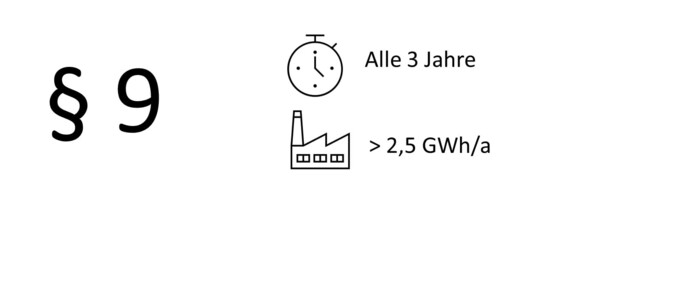
Realisation

  • Create and publish specific, feasible implementation plans
  • Implementation should be amortised after half of the useful life, after a maximum of 7.5 years
  • Economy in accordance with DIN EN 17463
Paragraph 9 of the Energy Efficiency Act

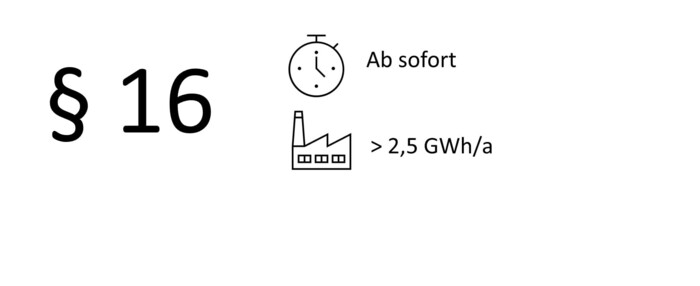
Avoidance and utilisation of waste heat

  • Avoid waste heat and use it through waste heat utilisation
  • Overall concept for the entire company premises and beyond (e.g. with pinch analysis) and use the waste heat generated in stages according to exergy content
  • Exception for plants requiring approval in accordance with BImSch
Paragraph 16 of the Energy Efficiency Act

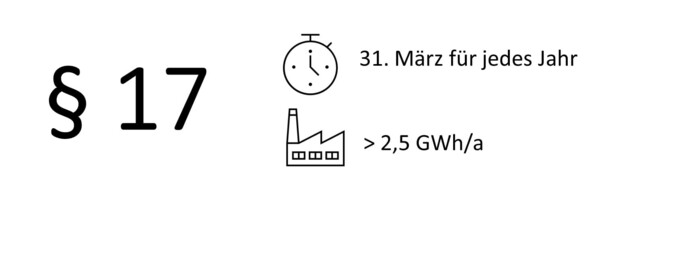
Platform for waste heat

  • Providing information on available waste heat to the Federal Office of Energy Efficiency and on request from heating network operators
  • The Federal Office of Energy Efficiency provides the information on a publicly accessible platform for waste heat
Paragraph 17 of the Energy Efficiency Act

What is the aim of the Energy Efficiency Act?

§1 Purpose of the Act

The Energy Efficiency Act determines the energy efficiency targets for primary and final energy consumption in Germany. This is achieved through measures to increase energy efficiency and the resulting reduction in energy consumption. In addition, the import and consumption of fossil fuels is to be reduced and contribute to improving security of supply and mitigating global climate change.

The purpose is to ensure the fulfilment of national energy efficiency targets and compliance with European targets.

§4 Energy efficiency targets

Quantitatively, the targets of the EnEfG are to be achieved by 2030, by reducing final energy consumption in Germany by at least 26.5 per cent compared to 2008. 26.5 per cent to a final energy consumption of 1,867 terawatt hours. terawatt hours. At the same time, the primary energy consumption is to be reduced by at least 39.3 per cent by 2030 to 2,252 terawatt hours by 2030. The second stage of the law, which extends to 2045, aims to reduce final energy consumption by 45 per cent compared to per cent compared to 2008. These targets will be reviewed and discussed again in 2027. reviewed and discussed.

What needs to be done?

In particular, the information obligation according to §17 requires the collection, preparation and transmission of the required information by 01 July 2024! The reporting deadline for the first year has been postponed to 1 July 2024, as the platform for waste heat is not yet available.

But also the establishment of energy and environmental management systems (for more than 7.5 GWh) with a deadline of 20 months (earliest deadline 18 July 2025) and the implementation of economic implementation plans with a deadline of 3 years (earliest deadline 18 November 2026) urgently require timely attention to these issues.

We help you to comply with the Energy Efficiency Act by identifying sources of waste heat and reducing it using pinch analysis as well as measures such as the recovery, refinement and sensible distribution of unavoidable waste heat.

We can also develop concepts with you and price them so that a decision on implementation is possible based on economic viability.

Our strategies for reducing waste heat

Our strategy for improving your energy utilisation is to increase:

  • Efficiency: We advise you on chillers with low energy requirements and waste heat utilisation.

  • Sufficiency: We try to make your processes more economical by directly avoiding waste heat, adjusting temperature levels or switching to other production processes.
  • Consistency: We rely on alternative technologies and exclusively on natural refrigerants to optimise your process in terms of nature and the environment. We develop our systems for a circular economy so that cycles are created from production, utilisation and recycling through to reuse. One example of this is our CryoProPhase, which efficiently recovers solvents instead of destroying them with high energy consumption. This reduces the demand for primary energy and raw materials in several ways.</li
You can find the exact text of the law at Energy Efficiency Act (EnEfG) and the 
Platform for reportable information at Federal Centre for Energy Efficiency.

Matching Services

Matching products

HOF-CryoBlizzard central cooling system for freeze-drying

HOF-CryoBlizzard central cooling system for freeze-drying

Centralised refrigeration system for freeze dryers with air as refrigerant - stable process, high efficiency and integrated charging storage for low operating costs.
Read more
CryoStorageCustom cryogenic storage -30 °C to -160 °C

CryoStorageCustom cryogenic storage -30 °C to -160 °C

Modular low-temperature storage system from -30 °C to -160 °C - scalable, energy-efficient and with reliable monitoring for safe long-term storage.
Read more
Fully automated high-density storage

Fully automated high-density storage

Fully automated high-density storage system at -80 °C - maximum sample density in a small area with robotic removal and significantly reduced energy consumption.
Read more
HOF-FTU Blood plasma freezer

HOF-FTU Blood plasma freezer

Compact blood plasma freezer with integrated refrigeration technology - fast, uniform freezing with a minimal footprint and high process reliability.
Read more
PharmaBlastFreeze

PharmaBlastFreeze

Blast freezer for GMP rapid freezing processes - high freezing capacity in a small space, reproducible results and energy-efficient operation.
Read more
RefoBlast

RefoBlast

Ultra-compact rapid freezer for blood plasma bags and bottles - controlled to -25 °C core temperature, efficient and with natural refrigerant.
Read more
Reactor cooling with the Mirai Intex MX machine

Reactor cooling with the Mirai Intex MX machine

Precise reactor cooling for chemicals, pharmaceuticals and biotech - dynamically controllable, reliably tempered and designed for demanding ultra-low temperatures.
Read more
Refosteel -80°C steel hardening plant

Refosteel -80°C steel hardening plant

Low-temperature hardening at -80 °C to improve material properties - precise, robust, reliable.
Read more
HOF-CryoProPhase cryocondensation for exhaust air purification & recycling

HOF-CryoProPhase cryocondensation for exhaust air purification & recycling

Cryo-condensation for exhaust air purification with solvent recovery - highly efficient VOC reduction through cryogenic cooling using air as a natural refrigerant.
Read more
CRYOCARGO110 Low-temperature trailer -40 °C to -110 °C

CRYOCARGO110 Low-temperature trailer -40 °C to -110 °C

Our low-temperature trailer for your emergency storage capacity and goods transport of demanding products.
Including 24/7 service hotline.
Read more
BioArc Ultra - -80°C Automated sample storage system

BioArc Ultra - -80°C Automated sample storage system

Automated -80 °C sample storage for biobanking - high-density storage with robotics and air-cycle refrigeration technology for maximum capacity with low energy requirements.
Read more
ULT 25 Mobile low temperature container -30 °C to -110 °C

ULT 25 Mobile low temperature container -30 °C to -110 °C

Mobile ULT container from -30 °C to -110 °C - fast deployment for distribution, low energy requirements and optional monitoring for a safe cold chain.
Read more
Cold and heat coupling with waste heat utilisation

Cold and heat coupling with waste heat utilisation

Utilises waste heat from refrigeration systems for processes or heating - increases overall efficiency and permanently reduces energy and CO₂ costs.
Read more
COOLINN whole-body cold chamber -115 °

COOLINN whole-body cold chamber -115 °

Whole-body refrigeration chamber down to -115 °C with natural refrigerants - high temperature homogeneity, environmentally friendly operation and reliable performance…
Read more

Neo Luna

Read more
Cornelia Schröder
Cornelia Schröder
Assistant to the management