Design criteria for low-temperature storage room technology

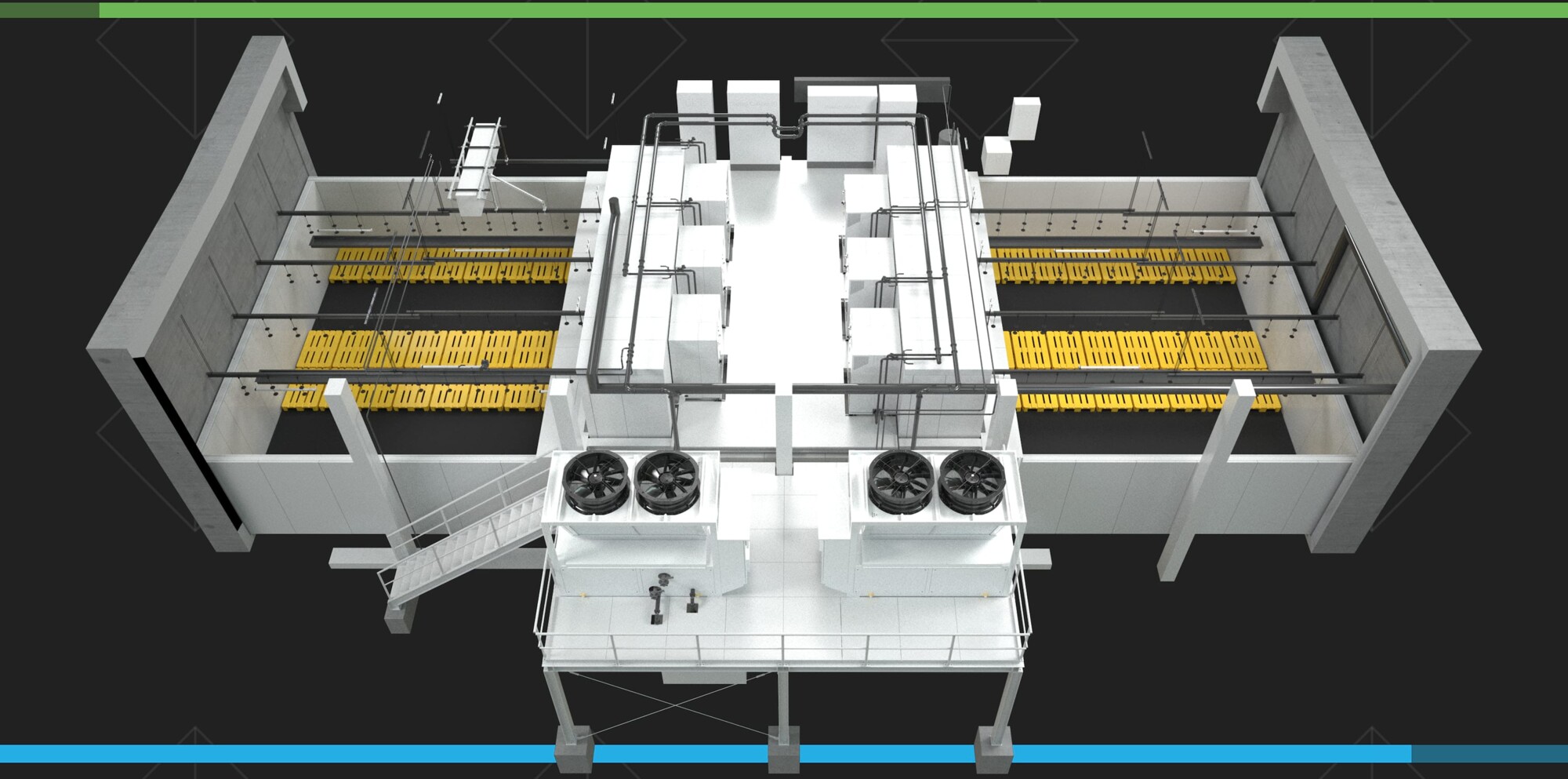
3D model of a cryogenic storage room

Features of cryogenic applications

Aufgrund der Entwicklung eines COVID-19-Impfstoffs und seiner besonderen Anforderungen rücken transportable Tiefkühllager immer mehr in den Fokus der kommenden Distribution. Dementsprechend wird der Markt derzeit mit Lösungen überschwemmt, so dass es zunehmend schwieriger wird, ein geeignetes von einem ungeeigneten Produkt zu unterscheiden. Mit unserer Übersichtsseite schaffen wir Klarheit und zeigen die wichtigsten Merkmale, die ein Tiefkühllagerraum haben sollte.

Features of cryogenic applications

The most important features of low-temperature applications in the temperature range from below 0°C to -160°C are explained below and the potential required in the following applications is shown.

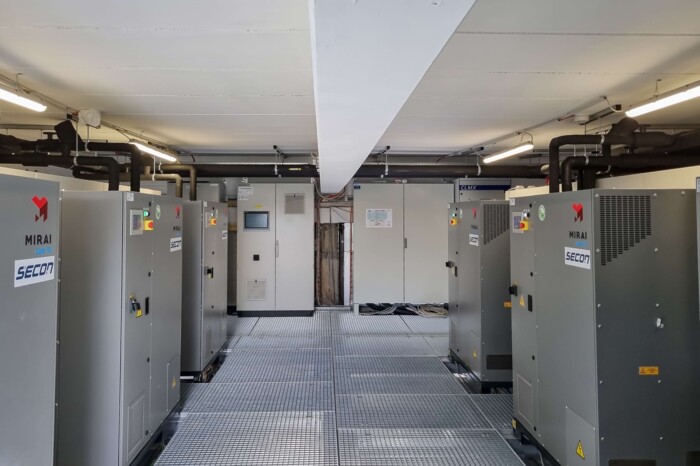
Engine room of the cryogenic warehouse

Insulation & specific surfaces

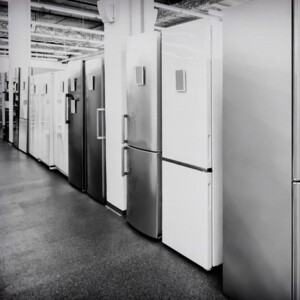
The larger the external surface area and the greater the temperature differences between the ambient temperature and the storage temperature, the greater the heat input. Good insulation is therefore essential for cryogenic storage. One option is to increase the wall thickness, but above a certain point this hardly brings any improvement in percentage terms and also limits the storage volume. Combinations of PU foam and integrated vacuum panels provide a remedy, resulting in low wall thicknesses with high insulation values. The outer surface is significantly influenced by the geometry. It therefore makes sense to keep the ratio of volume to surface area as small as possible. The quotient of external surface area and storage volume, the so-called specific surface area, is used as a reference value. To illustrate this, consider several individual refrigerators compared to a large storage room. As a rule, larger appliances are more efficient than smaller ones. But even if many fridges are operated in the same way as one storage room, they differ considerably in terms of energy consumption because the individual fridges have a much larger specific surface area than the storage room. This can account for a factor of 10 in energy consumption.

Nature provides a perfect example here. If you look at two different penguin species based on their habitats, you can see how drastic this influence is:


Specific surface using the example of a penguin

Emperor penguin
Emperor penguin
  • Low specific surface area
  • Low energy consumption per body volume
  • lives in the Antarctic
  • survives temperatures down to approx. -50°C
African penguin
African penguin
  • Large specific surface area
  • High energy consumption per body volume
  • lives in South Africa
  • needs temperatures above 0°C to survive

Specific volume using the example of a storage room

a large low-temperature storage room
  • Low specific surface area
  • Low energy consumption per body volume per storage volume
  • Low, external heat input
  • efficient
  • Low operating costs
Many small low-temperature refrigerators
  • Large specific surface area
  • High energy consumption per storage volume
  • High external heat input
  • inefficient
  • High operating costs

Refrigeration technology & regulations

Powerful and efficient refrigeration technology is important for deep-freeze storage. The energy input from the environment (transmission), the waste heat from the electrical installation and the loading and unloading lead to a corresponding power requirement. In addition, humidity must be constantly removed from the cold room.</p

When it comes to refrigeration technology, it is also important to ensure that it does not fall under the applicable regulations or is regulated by them. This currently relates to the Global Warming Potential (GWP) value, which will be reduced to an average of around 500 by 2030 as a result of the quota system of the European F-Gas Regulation and already prohibits refrigerants with a GWP of over 2500 for normal applications.
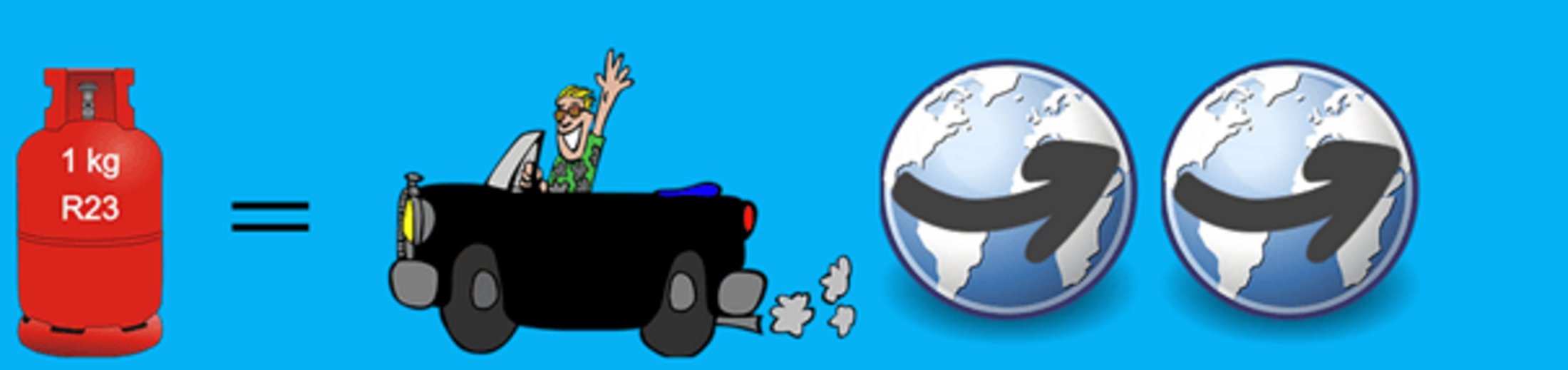
Caricature of a gas cylinder that is equivalent to a car that can circle the earth twice

High load due to refrigerant R23

In concrete terms, this means that a single kilo of R23 has as much global warming potential as the amount of CO2 emitted by a car travelling around the world twice.

We deliberately use the natural refrigerant ambient air for cooling. This makes you future-proof and environmentally friendly. What's more, you don't need any additional safety measures as with other natural refrigerants such as ethane, ammonia and CO2.

The low-temperature refrigerant R23

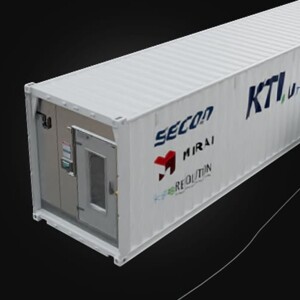
The low-temperature refrigerant R23 with a GWP value of 14900 can still be used due to an exemption. However, this is definitely not advisable. It is currently massively affected by the shortage due to the quota regulation. New systems with this refrigerant are questionable and harmful to the environment. To make the environmental impact tangible, we compare the CO2 equivalent of one kilo of R23 with the distance a car could travel to emit the same amount of CO2. In concrete terms, this means that a single kilo of R23 has as much global warming potential as the amount of CO2 a car would emit if it travelled around the world twice. We deliberately use the natural refrigerant ambient air for cooling. This makes you future-proof and environmentally friendly. What's more, you don't need any additional safety measures as with other natural refrigerants such as ethane, ammonia and CO2.

Loading and unloading processes

Opening the access to the storage room creates a short, large air flow that brings a lot of warm air into the cold room. This has a drastic effect, especially in low-temperature applications, as the difference in density between the storage room and the anteroom is high due to the temperature difference. This means that the cold air falls into the anteroom when the door is opened. By integrating an airlock, which is tempered as a buffer zone only by transmission and convection from the cold room, the influence of loading/unloading remains low.

Electrical installations

Conventional cooling systems require an evaporator in the cold room. This is equipped with a fan and a fan heater and must be thermally defrosted at regular intervals. Both components and the defrosting process generate a lot of heat in the cold room. In addition, no active cooling can take place during defrosting. With open cold air coolers, an evaporator is no longer necessary, which eliminates these heat sources and enables continuous cooling. This makes the low-temperature storage room with cold air coolers more efficient. In addition, all electrical installations should be well thought out and suitable for the storage temperature.

Find suitable products for the realisation of your deep-freeze logistics

HOF-CryoBlizzard central cooling system for freeze-drying

HOF-CryoBlizzard central cooling system for freeze-drying

Centralised refrigeration system for freeze dryers with air as refrigerant - stable process, high efficiency and integrated charging storage for low operating costs.
Read more
CryoStorageCustom cryogenic storage -30 °C to -160 °C

CryoStorageCustom cryogenic storage -30 °C to -160 °C

Modular low-temperature storage system from -30 °C to -160 °C - scalable, energy-efficient and with reliable monitoring for safe long-term storage.
Read more
Fully automated high-density storage

Fully automated high-density storage

Fully automated high-density storage system at -80 °C - maximum sample density in a small area with robotic removal and significantly reduced energy consumption.
Read more
HOF-FTU Blood plasma freezer

HOF-FTU Blood plasma freezer

Compact blood plasma freezer with integrated refrigeration technology - fast, uniform freezing with a minimal footprint and high process reliability.
Read more
PharmaBlastFreeze

PharmaBlastFreeze

Blast freezer for GMP rapid freezing processes - high freezing capacity in a small space, reproducible results and energy-efficient operation.
Read more
RefoBlast

RefoBlast

Ultra-compact rapid freezer for blood plasma bags and bottles - controlled to -25 °C core temperature, efficient and with natural refrigerant.
Read more
Reactor cooling with the Mirai Intex MX machine

Reactor cooling with the Mirai Intex MX machine

Precise reactor cooling for chemicals, pharmaceuticals and biotech - dynamically controllable, reliably tempered and designed for demanding ultra-low temperatures.
Read more
Refosteel -80°C steel hardening plant

Refosteel -80°C steel hardening plant

Low-temperature hardening at -80 °C to improve material properties - precise, robust, reliable.
Read more
HOF-CryoProPhase cryocondensation for exhaust air purification & recycling

HOF-CryoProPhase cryocondensation for exhaust air purification & recycling

Cryo-condensation for exhaust air purification with solvent recovery - highly efficient VOC reduction through cryogenic cooling using air as a natural refrigerant.
Read more
CRYOCARGO110 Low-temperature trailer -40 °C to -110 °C

CRYOCARGO110 Low-temperature trailer -40 °C to -110 °C

Our low-temperature trailer for your emergency storage capacity and goods transport of demanding products.
Including 24/7 service hotline.
Read more
BioArc Ultra - -80°C Automated sample storage system

BioArc Ultra - -80°C Automated sample storage system

Automated -80 °C sample storage for biobanking - high-density storage with robotics and air-cycle refrigeration technology for maximum capacity with low energy requirements.
Read more
ULT 25 Mobile low temperature container -30 °C to -110 °C

ULT 25 Mobile low temperature container -30 °C to -110 °C

Mobile ULT container from -30 °C to -110 °C - fast deployment for distribution, low energy requirements and optional monitoring for a safe cold chain.
Read more
Cold and heat coupling with waste heat utilisation

Cold and heat coupling with waste heat utilisation

Utilises waste heat from refrigeration systems for processes or heating - increases overall efficiency and permanently reduces energy and CO₂ costs.
Read more
COOLINN whole-body cold chamber -115 °

COOLINN whole-body cold chamber -115 °

Whole-body refrigeration chamber down to -115 °C with natural refrigerants - high temperature homogeneity, environmentally friendly operation and reliable performance…
Read more

Neo Luna

Read more

Find the right technical information on deep-freeze logistics

Find our services

Christian Berger

Christian Berger · Head - Process and technology manager for aseptics and sterility

Refolution supported me in the technical verification of the design and dimensioning of a cooling system with natural refrigerant for a new freeze-drying plant.
I was very pleased with the immediate support and expertise of the Refolution team. Thank you very much for your help.
Cornelia Schröder
Cornelia Schröder
Assistant to the management