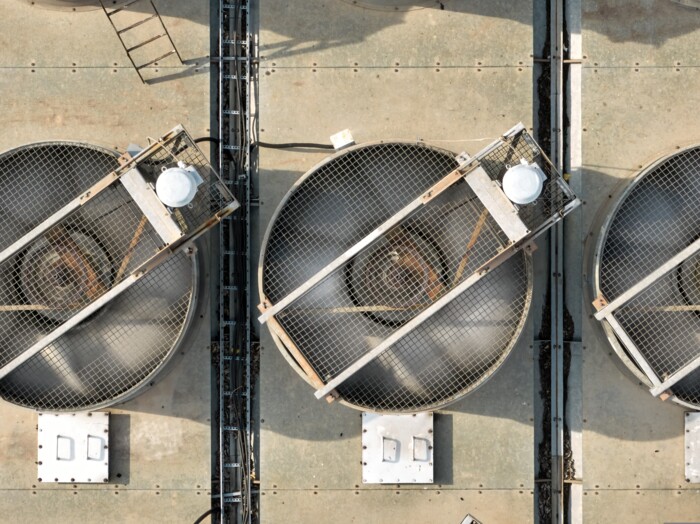
Heat exchanger - Free Cooling system

Your application Free cooling

Today's cooling systems are usually equipped with various technologies to ensure efficient cooling performance. One such technology that is used in many applications is "free cooling" or "free cooling". In this article, we will take a closer look at free cooling and the chiller with free cooling.

What is free cooling?

Free cooling is a cooling system that utilises natural ambient temperatures to achieve air cooling without the need for additional energy. Unlike conventional cooling systems that rely solely on electrical cooling methods, free cooling can be a cost-effective and energy-efficient alternative in suitable environmental conditions. The way free cooling works is that outside air or cold water is used to dissipate the heat and create the cooling effect. This takes place via a heat exchange process in which the warm air or warm water is brought into contact with the cooling environment. Thanks to this natural cooling, free cooling can save a considerable amount of energy and therefore reduce costs.

Definition and function of free cooling

Free cooling refers to the utilisation of the ambient temperature for cooling rooms or systems. The heat is dissipated through contact with cold outside air or cold water. The cooling system therefore utilises natural cooling resources instead of relying solely on electrical cooling methods.
Free cooling is usually used in combination with other cooling systems to achieve optimum cooling performance. If the ambient temperature is low enough, free cooling alone can be sufficient to meet the cooling demand, significantly reducing the energy consumption of the chiller.

Free Cooler
Free Cooler

Advantages and disadvantages of free cooling

Free cooling offers a number of advantages that make it an attractive option:

Energy savings: As free cooling utilises the natural ambient temperature, energy consumption can be significantly reduced. This leads to cost savings and improved energy efficiency.</p

Sustainability: Due to its low energy consumption and use of natural resources, free cooling is more environmentally friendly than conventional cooling systems.</p

Cost efficiency: As no additional energy is required for cooling, operating costs can be significantly reduced.</p

Reliability: Free cooling can also serve as a backup system in case the primary cooling system fails or requires maintenance.

Although free cooling offers many advantages, there are also some disadvantages that should be considered:

Dependence on environmental conditions: For free cooling to work effectively, certain environmental conditions, such as a sufficiently low outside temperature, are required. In regions with high temperatures or high humidity, free cooling may be less efficient.

<p

Restrictions in terms of application areas: Not all applications are suitable for free cooling. Particularly in areas where a constant cooling temperature is required, conventional cooling systems may be more suitable.

Innovative technology

Free cooling with air is an innovative technology that is used in various industries. In data centres, for example, where constant cooling is required, free cooling in combination with other cooling systems can help to reduce energy consumption. By utilising natural ambient temperatures, companies can cut costs and reduce their environmental impact at the same time. Another area where free cooling is used is the food industry. Here it is important to ensure the right temperature for food storage. Free cooling can help to reduce energy costs while maintaining the quality and freshness of the products. In the automotive industry, free cooling is also used to regulate the temperature of vehicle engines. By utilising the ambient temperature, energy consumption can be reduced and the efficiency of the cooling process improved. Free cooling is a promising technology that can help reduce energy consumption and minimise environmental impact. By utilising natural resources and avoiding additional energy costs, free cooling can be a sustainable and cost-effective solution for various applications.

Column tower
Column tower

Chiller with free cooling

The free cooling chiller is a special type of refrigeration system that utilises free cooling to achieve an efficient cooling capacity.

How a free cooling chiller works:

The free cooling chiller works in a similar way to conventional chillers, but also uses free cooling to minimise energy consumption. In suitable environmental conditions, the cold outside air or cold water is used to support the chiller and make mechanical cooling more efficient.

Advantages of a chiller with free cooling

The use of a chiller with free cooling offers various advantages:

Energy savings: By utilising free cooling, energy consumption can be significantly reduced, resulting in cost savings.</p

Improved energy efficiency: The free cooling chiller is more energy efficient than conventional chillers and therefore contributes to sustainability.

Flexibility: The free cooling chiller can be used in combination with other cooling systems to optimise cooling capacity.

Application examples for chillers with free cooling

Chillers with free cooling are used in various areas of application:

Free cooling in industry:
Industrial cooling systems with free cooling for various purposes, such as the air conditioning of production facilities or the cooling of industrial processes. The efficient use of free cooling can reduce operating costs and improve energy efficiency.

Free cooling in building technology:
In building technology, chillers with free cooling based on air as a refrigerant are used to cool rooms and improve the indoor climate. Especially in office buildings or shopping centres where constant cooling is required, free cooling can be a cost-effective option.

Cooling units
Cooling units

Future prospects for free cooling and chillers:

In view of the growing demand for energy-efficient solutions and the increasing importance of environmental protection, there are promising prospects for the future of free cooling and chillers:

Technological developments and trends:

Free cooling and chillers themselves are constantly being developed to be even more efficient and sustainable. New technological developments are enabling better control and optimisation of cooling capacity, while trends such as the integration of renewable energies are further driving the use of free cooling.

<p

Environmental impact and energy efficiency:

In light of concerns about climate change and rising energy consumption, the importance of energy-efficient cooling systems is growing. Free cooling and chillers play an important role in this, as they can contribute to a reduction in greenhouse gas emissions and greater energy efficiency.

<p

Overall, free cooling in combination with chillers offers a promising solution for energy-efficient cooling. By utilising natural resources and reducing energy consumption, costs can be lowered and the environment protected. As technological developments progress and awareness of sustainability increases, free cooling and chillers will continue to play an important role in the future.

Here you will find suitable products and services

Matching products

HOF-CryoBlizzard central cooling system for freeze-drying

HOF-CryoBlizzard central cooling system for freeze-drying

Centralised refrigeration system for freeze dryers with air as refrigerant - stable process, high efficiency and integrated charging storage for low operating costs.
Read more
CryoStorageCustom cryogenic storage -30 °C to -160 °C

CryoStorageCustom cryogenic storage -30 °C to -160 °C

Modular low-temperature storage system from -30 °C to -160 °C - scalable, energy-efficient and with reliable monitoring for safe long-term storage.
Read more
Fully automated high-density storage

Fully automated high-density storage

Fully automated high-density storage system at -80 °C - maximum sample density in a small area with robotic removal and significantly reduced energy consumption.
Read more
HOF-FTU Blood plasma freezer

HOF-FTU Blood plasma freezer

Compact blood plasma freezer with integrated refrigeration technology - fast, uniform freezing with a minimal footprint and high process reliability.
Read more
PharmaBlastFreeze

PharmaBlastFreeze

Blast freezer for GMP rapid freezing processes - high freezing capacity in a small space, reproducible results and energy-efficient operation.
Read more
RefoBlast

RefoBlast

Ultra-compact rapid freezer for blood plasma bags and bottles - controlled to -25 °C core temperature, efficient and with natural refrigerant.
Read more
Reactor cooling with the Mirai Intex MX machine

Reactor cooling with the Mirai Intex MX machine

Precise reactor cooling for chemicals, pharmaceuticals and biotech - dynamically controllable, reliably tempered and designed for demanding ultra-low temperatures.
Read more
Refosteel -80°C steel hardening plant

Refosteel -80°C steel hardening plant

Low-temperature hardening at -80 °C to improve material properties - precise, robust, reliable.
Read more
HOF-CryoProPhase cryocondensation for exhaust air purification & recycling

HOF-CryoProPhase cryocondensation for exhaust air purification & recycling

Cryo-condensation for exhaust air purification with solvent recovery - highly efficient VOC reduction through cryogenic cooling using air as a natural refrigerant.
Read more
CRYOCARGO110 Low-temperature trailer -40 °C to -110 °C

CRYOCARGO110 Low-temperature trailer -40 °C to -110 °C

Our low-temperature trailer for your emergency storage capacity and goods transport of demanding products.
Including 24/7 service hotline.
Read more
BioArc Ultra - -80°C Automated sample storage system

BioArc Ultra - -80°C Automated sample storage system

Automated -80 °C sample storage for biobanking - high-density storage with robotics and air-cycle refrigeration technology for maximum capacity with low energy requirements.
Read more
ULT 25 Mobile low temperature container -30 °C to -110 °C

ULT 25 Mobile low temperature container -30 °C to -110 °C

Mobile ULT container from -30 °C to -110 °C - fast deployment for distribution, low energy requirements and optional monitoring for a safe cold chain.
Read more
Cold and heat coupling with waste heat utilisation

Cold and heat coupling with waste heat utilisation

Utilises waste heat from refrigeration systems for processes or heating - increases overall efficiency and permanently reduces energy and CO₂ costs.
Read more
COOLINN whole-body cold chamber -115 °

COOLINN whole-body cold chamber -115 °

Whole-body refrigeration chamber down to -115 °C with natural refrigerants - high temperature homogeneity, environmentally friendly operation and reliable performance…
Read more

Neo Luna

Read more

Matching Services

Information on

Cornelia Schröder
Cornelia Schröder
Assistant to the management