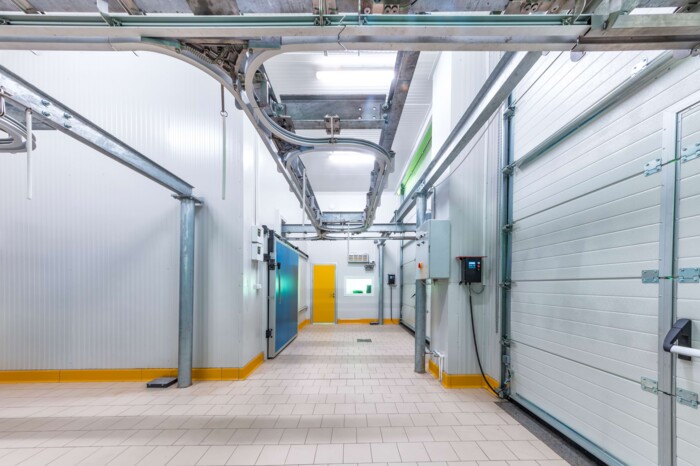
Plasma bottle freezing

Plasma bottle freezing is a professional solution for the rapid cooling process in modern medical technology. Our plasma blast chiller utilises the most advanced cryogenic technology to handle complex thermal processes and cool liquid helium in the double chamber freezing process. With this innovative and efficient approach, we ensure that your material is cooled reliably and safely under the most demanding conditions. Our professional blast chiller can be customised to your requirements and configured for specific applications, allowing you to benefit from the full power of the technology.

Shock freezing is an important process in pharmaceutical API production and has many applications in the industry. Deep-freeze storage plays a crucial role in the storage of pharmaceutical APIs and monoclonal antibodies in particular. Dry ice containers are also of great importance in the pharmaceutical industry. In this article, we will provide an insight into the blast freezer industry, the role of deep-freeze storage and the challenges of monoclonal antibody storage, as well as the function and safety aspects of dry ice containers.

Introduction to the blast freezer industry

The shock freezer is an important tool for industrial applications. With its ability to cool monoclonal antibodies to a minimal level in the shortest possible time, it is ideal for research and development. Through its various functions, including support for cell culture, life sciences, genetic testing and molecular methods, laboratories can achieve greater control over their applications. Equipped with temperature controllers that generate both positive and negative temperatures and patented subcooling cycles, the blast freezer can be configured and optimised for each application. This makes the blast chiller a productive part of research.

Cryogenic storage rooms

The blast freezer industry is a sector that deals with the development and production of blast freezers. Blast freezers are specialised devices that can bring food, medicines and other products to very low temperatures in a short period of time. This process of blast freezing has numerous advantages, such as ensuring better freshness and quality of the products. Blast freezing is a process that is used in various industries. It has proven to be extremely effective in extending the shelf life of food and improving the quality of pharmaceutical products. But how exactly does blast freezing work and why is it so important? Blast freezing is a process in which products are brought to a very low temperature of up to -120 °C within a short period of time. This blast chiller has a sophisticated technology. The products are placed in the blast chiller and quickly brought to the desired temperature using a combination of cold and airflow.

The importance of shock freezing in pharmaceutical API production

Shock freezing plays a crucial role in the stabilisation of active pharmaceutical ingredients in pharmaceutical API production. By using shock freezers, active pharmaceutical ingredients can be quickly brought to very low temperatures to ensure their effectiveness and shelf life. This is particularly important as many active pharmaceutical ingredients are sensitive to heat and moisture.
Shock freezing enables manufacturers to guarantee the quality and efficacy of their medicines. Rapid cooling of the active ingredients prevents unwanted chemical reactions and improves the stability of the products. This is crucial to ensure that medicines retain their efficacy over a longer period of time.
In addition, blast freezing enables manufacturers to increase production efficiency. By using blast freezers, large quantities of active pharmaceutical ingredients can be processed in a short period of time, resulting in faster production and higher productivity.

Shock freezing in the pharmaceutical industry

Areas of application for shock freezing in industry

Shock freezing has a wide range of applications in the industry. In the food industry, for example, it is used to extend the shelf life of food and improve flavour and texture. The rapid cooling of the food kills microorganisms and prevents bacteria and fungi from multiplying. In the chemical industry, shock freezing is used to stabilise chemicals and prevent undesirable reactions, which leads to higher product quality and safety. Shock freezing is also used in the cosmetics industry to extend the shelf life of products and improve their quality. The rapid cooling of cosmetic ingredients prevents undesirable changes in texture and appearance. Overall, shock freezing has a major impact in various industries. It enables manufacturers to improve the quality and shelf life of their products while making production processes more efficient. The blast freezing industry therefore plays an important role in modern industry and is expected to continue to grow and develop.

Deep-freeze storage and its role in the Pharma API

Freezer storage plays a crucial role in the storage of pharmaceutical APIs and monoclonal antibodies in particular. They provide optimal conditions for the long-term storage of temperature-sensitive products.

Basics of frozen storage:
Frozen storage refers to the storage of products at extremely low temperatures, usually below -20°C. This process slows down metabolism and microbial activity. This process slows down metabolism and microbial activity, extending product shelf life. Deep-freeze warehouses are equipped with state-of-the-art cooling technologies that enable precise temperature control and monitoring.</p

Freezer storage of monoclonal antibodies:
Monoclonal antibodies are of great importance in medicine and are used to treat various diseases. Due to their sensitivity to heat and humidity, storage at low temperatures is essential. Frozen storage provides the ideal conditions to maintain the stability and efficacy of monoclonal antibodies.

Deep-freeze warehouse

Monoclonal antibodies and their storage

Monoclonal antibodies are artificially produced antibodies that can bind specifically to certain molecules. They are used in medical research and therapy and have great potential in the treatment of diseases such as cancer. The correct storage of monoclonal antibodies is crucial to ensure their effectiveness.</p

What are monoclonal antibodies?

Monoclonal antibodies are proteins that are produced in the laboratory and can bind specifically to certain molecules, known as antigens. They are isolated from special cells, the B cells, and produced in large quantities. Monoclonal antibodies have different properties and applications depending on which molecules they are directed against.

<p

Challenges in the storage of monoclonal antibodies:

Storage of monoclonal antibodies is a challenge as they are sensitive to temperature fluctuations and improper handling. The use of deep-freeze storage offers a solution to ensure the stability and efficacy of monoclonal antibodies. In addition, careful monitoring of storage conditions and adherence to proper transport and storage protocols is also of great importance.

Dry ice containers in the pharmaceutical industry

Dry ice containers play an important role in the storage and transport of temperature-sensitive products in the pharmaceutical industry and blast freezers for industrial applications. They are based on the use of dry ice, which consists of solid carbon dioxide and sublimates at very low temperatures.

Dry ice containers use dry ice to maintain a low temperature for the transport or storage of products. The dry ice sublimates slowly, creating a cold environment. This makes dry ice containers an effective solution for transporting temperature-sensitive products, including pharmaceutical APIs and monoclonal antibodies.

Liquid nitrogen
Liquid nitrogen

Safety aspects when using dry ice containers

When using dry ice containers, certain safety aspects must be taken into account. As the dry ice releases carbonated gas, the container should be well ventilated to prevent the gas from accumulating. In addition, it is important that the dry ice is not touched directly, as it can cause burns at low temperatures. Overall, blast chillers, freezer storage and dry ice containers play a crucial role in the blast chiller industry, in the storage of pharma API and monoclonal antibodies. Proper application and adherence to prescribed procedures and storage conditions are critical to maintaining product quality and efficacy. In addition, these technologies enable innovation in medicine and the development of new therapies to improve the health and well-being of patients.

Matching products

HOF-CryoBlizzard central cooling system for freeze-drying

HOF-CryoBlizzard central cooling system for freeze-drying

Centralised refrigeration system for freeze dryers with air as refrigerant - stable process, high efficiency and integrated charging storage for low operating costs.
Read more
CryoStorageCustom cryogenic storage -30 °C to -160 °C

CryoStorageCustom cryogenic storage -30 °C to -160 °C

Modular low-temperature storage system from -30 °C to -160 °C - scalable, energy-efficient and with reliable monitoring for safe long-term storage.
Read more
Fully automated high-density storage

Fully automated high-density storage

Fully automated high-density storage system at -80 °C - maximum sample density in a small area with robotic removal and significantly reduced energy consumption.
Read more
HOF-FTU Blood plasma freezer

HOF-FTU Blood plasma freezer

Compact blood plasma freezer with integrated refrigeration technology - fast, uniform freezing with a minimal footprint and high process reliability.
Read more
PharmaBlastFreeze

PharmaBlastFreeze

Blast freezer for GMP rapid freezing processes - high freezing capacity in a small space, reproducible results and energy-efficient operation.
Read more
RefoBlast

RefoBlast

Ultra-compact rapid freezer for blood plasma bags and bottles - controlled to -25 °C core temperature, efficient and with natural refrigerant.
Read more
Reactor cooling with the Mirai Intex MX machine

Reactor cooling with the Mirai Intex MX machine

Precise reactor cooling for chemicals, pharmaceuticals and biotech - dynamically controllable, reliably tempered and designed for demanding ultra-low temperatures.
Read more
Refosteel -80°C steel hardening plant

Refosteel -80°C steel hardening plant

Low-temperature hardening at -80 °C to improve material properties - precise, robust, reliable.
Read more
HOF-CryoProPhase cryocondensation for exhaust air purification & recycling

HOF-CryoProPhase cryocondensation for exhaust air purification & recycling

Cryo-condensation for exhaust air purification with solvent recovery - highly efficient VOC reduction through cryogenic cooling using air as a natural refrigerant.
Read more
CRYOCARGO110 Low-temperature trailer -40 °C to -110 °C

CRYOCARGO110 Low-temperature trailer -40 °C to -110 °C

Our low-temperature trailer for your emergency storage capacity and goods transport of demanding products.
Including 24/7 service hotline.
Read more
BioArc Ultra - -80°C Automated sample storage system

BioArc Ultra - -80°C Automated sample storage system

Automated -80 °C sample storage for biobanking - high-density storage with robotics and air-cycle refrigeration technology for maximum capacity with low energy requirements.
Read more
ULT 25 Mobile low temperature container -30 °C to -110 °C

ULT 25 Mobile low temperature container -30 °C to -110 °C

Mobile ULT container from -30 °C to -110 °C - fast deployment for distribution, low energy requirements and optional monitoring for a safe cold chain.
Read more
Cold and heat coupling with waste heat utilisation

Cold and heat coupling with waste heat utilisation

Utilises waste heat from refrigeration systems for processes or heating - increases overall efficiency and permanently reduces energy and CO₂ costs.
Read more
COOLINN whole-body cold chamber -115 °

COOLINN whole-body cold chamber -115 °

Whole-body refrigeration chamber down to -115 °C with natural refrigerants - high temperature homogeneity, environmentally friendly operation and reliable performance…
Read more

Neo Luna

Read more

Matching Services

Cornelia Schröder
Cornelia Schröder
Assistant to the management